
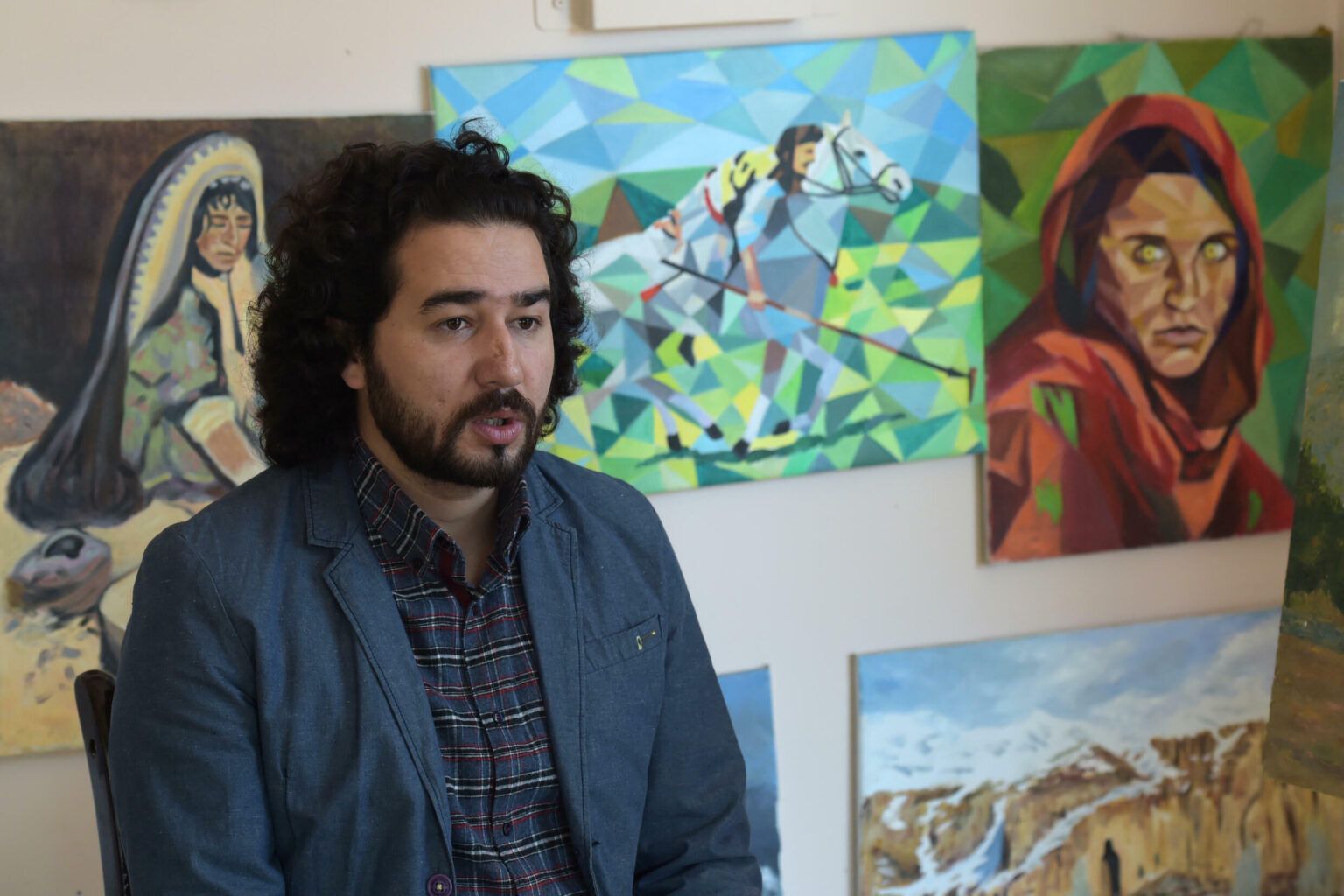
Five years ago, on August 15, 2021, Kabul was captured by the Taliban. For thousands of Afghans, that date marks much more than a political shift. Among them is ArtLords President and Co-Founder Omaid Sharifi, for whom that day reinforced a lifelong calling: to bring hope, foster connection, and build community through art.
ArtLords is a collective of artists-activists who use art to advocate for human rights and social change. Now headquartered in the Washington DC region, they bring lived experiences to life in the form of beautiful paintings and murals. ArtLords stands as a symbol of love, community, and hope – especially for women and young girls whose voices are often marginalized.
When the Taliban seized Kabul, one of its first actions was to cover and destroy over 2,000 ArtLords murals across Afghanistan. These messages of love, hope, and compassion that once filled public spaces were lost. But the loss was greater than paint on a wall. Each mural represented a story, a voice, and a vision for a more inclusive future. Their destruction underscores the very reason Omaid and ArtLords continue their work today: ensuring those stories are honored and not forgotten.
Omaid recently joined Christine Dunn, LSSNCA’s director of development, for a conversation about art, activism, the power of storytelling, and the beauty of community.
Five Years After Kabul: A Conversation with Omaid Sharifi
Omaid: August — especially this August — is a little bit hard for me and I think for a lot of Afghans who have left their country. I vividly remember the second week in August [2021], while being in Kabul, the provinces were falling to the Taliban.
Speaking about those days is extremely hard because I never had a chance to look back at those moments — of having a backpack, having just the clothes on my back, and leaving everything I knew — over 35 years of my life. I compartmentalized parts of my mind because if I had to go and process that trauma, I think I would need a lot of time. And that is something I don’t have.
What really triggered [me] the other day [was] the shoes that I came in with from Kabul airport when I arrived in Virginia. I kept only those shoes. It is the only memory I will keep with me all my life. I was going into DC, and I saw a big pile of shoes that my wife wanted to donate. I was rushing, but, in my heart, I thought maybe she might have put those shoes in that box. But I did not have time, so I went to my meeting.
I came back and the first thing I asked [her] was “Where are the shoes?” She had donated them. I told her, “I think my shoes were in there.” [They are] the only connection I have with Kabul — in terms of what I brought with me emotionally — I brought with me walking with those shoes. For one moment, every trauma that I had in my mind broke down. I was crying. So, I went to the collections place and got my shoes back.
Christine: Our sense of home and belonging is often tied to the places around us; the streets, buildings, and landmarks that we see daily that become familiar to us. When you came to the United States, how did encountering a different visual and cultural landscape shape your own sense of home and belonging? Has the concept of “home” and what makes someplace feel like “home” changed through your experiences?
Omaid: One of the first things I was missing when I left Afghanistan was the stone mountains. For us living in Kabul, we are surrounded by mountains. We are the mountain people. When I arrived in Virginia and in DC, I was really lost in terms of direction, geography, and time of the day. I think there is a connection between me and my mountains. That is the biggest thing that I miss.
Christine: Your story reminds me that the narratives we hear most often are usually shaped by those who hold power. One of the gifts that artists have is that they can help tell stories that otherwise do not make it into mainstream conversation. A challenge with curated museums is that in showing the famous paintings and the famous artists, you lose out on some of the more intimate stories and perspectives that ArtLords is trying to highlight. I like that ArtLords puts their heart into telling everybody’s story.
Omaid: I am more concerned about the artists who are alive. They live in poverty and indignity all over the world. One of the missions of ArtLords is showing my care for alive artists. I want to make sure they are comfortable creating art. The artist community is the crème of society; they are the best of humanity. I hope we succeed in our mission and encourage some of the 1% to support the alive artists.
Christine: During the capture of Kabul, over 2,000 ArtLords murals were destroyed or painted over. One of the calls of ArtLords is to repaint the murals in the United States. What does it mean to recreate something that was intentionally destroyed?
Omaid: Over 2,200 ArtLords murals were gone in the first few weeks of Taliban’s rule. It showed the importance of these murals and the message we were delivering, and it was one of the symbols of this liberal Afghanistan we were fighting for. We are recreating some of these murals not just in the United States, but in all parts of the world because I want different cities in the United States send to a message of solidarity with the artists still in Afghanistan.
But it is also an act of resistance. It shows solidarity with the people of the world who are standing for the art. If you are destroying this mural in one part of the world, another part of the world is inviting us to repaint that mural. It is a human, kind gesture from the people and cities who have welcomed us.
Christine: When you were talking, it reminded me so much of the resurrection story – one of rising from the ashes. Death does not have the final word; there is always goodness. I love that you are using your murals to say that.
Omaid: If you look at the history of the world, you have had a lot of terrorists, tyrants, oppressors. They are all gone. But I am recording this history as well. The historians are doing it; the students are writing about this; but what I capture with our work here at ArtLords [is] also capturing the emotions of this time.
We are keeping the political memory of this time alive.
Christine: ArtLords has a history of using public murals and art to make space for the people whose voices have been overlooked, including those of women and girls. Today, women and girls in Afghanistan are facing increased restrictions from education, employment, and dignified healthcare.
At a time when women are facing discrimination and injustice in Afghanistan, what does it mean to you and the collective at ArtLords to continue telling the stories of the voiceless and uplifting their experiences through art?
Omaid: Every day I talk to people in Afghanistan. My message to them and to these artists is that I care for them. I want them to know that I care.
Empathy is important. At the same time, the creative resistance has to go out. Because the Taliban are afraid of art, they have banned the expression of art. Because it has a message. Because art will promote critical thinking, will make people ask question, give people hope — and they want to kill hope. So, we have continued this work.
Over 2.6 million girls cannot go to high school in Afghanistan. [So many] women and girls have turned to art. We are the only organization doing something like that, so imagine the responsibility on my shoulders and the importance of this work at this point in time in history.
The girls are telling me they need this; this is the only thing that gives me wind of the outside. They are very brave. They are the bravest people I know. They create art in front of this terrorist group that only thinks of humans as subjects.
Christine: Healing Through Art is a program led by professional therapists and artists. Can you share more about how ArtLords is using art as a healing tool?
Omaid: One of the flagship activities that ArtLords has been doing inside and outside of Afghanistan, especially with female artists, and with refugee community is body mapping in therapy. We have tested and produced some techniques; we are trying to make sure we are processing some of the grief through those techniques. Those have been incredibly successful with small groups in the refugee community.
What mapping does is bring a small group of intimate people together and starts with vulnerability from our side. We share our stories, our pain, our sorrows, the challenges. We ask you to think — What color is hate? What color is love? What symbol do you draw of hope? What does all of this look like on your shoulders?
We are offering it for free, so it is available in the DMV for any refugee community.
Christine: Where are you seeing promise right now?
Omaid: I see a lot of promise in the young generation, be it in Afghanistan or the United States. I have seen signs of resistance and hope. They are very creative in the way they are solving problems and critically thinking, especially the kids and women in Afghanistan.
The Taliban thought they would ban women and girls from public life. But what happens is the way they have educated themselves, the way they are creating art, the way they are creating stories, the way they are writing – I think they will be the most educated generation this country has ever had. I think if there is a way Afghanistan will be saved, it will be [by] the women of this country.


